Data Dictionary for Analytics: Define Metrics Once
Someone on your team builds a report called “Active Users.” Someone else builds one called “Active Users.” The numbers do not match. After an hour of investigation you discover the two reports define “active” completely differently — and nobody wrote either definition down. That gap is exactly what a data dictionary for analytics closes.
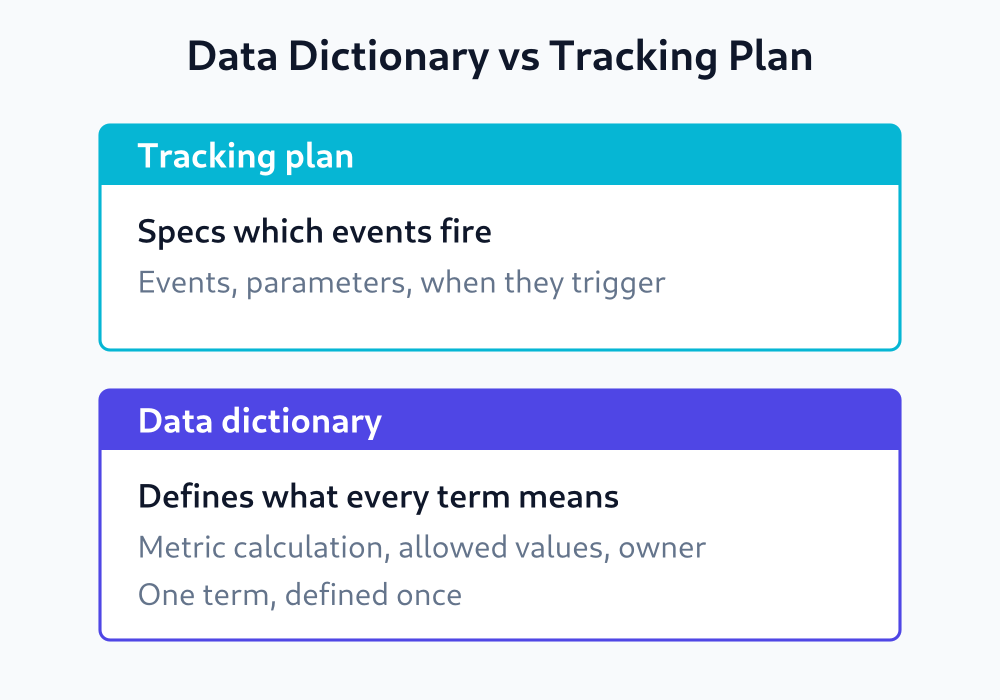
A tracking plan tells you which events fire. A data dictionary tells you what every metric, dimension, and field actually means. Without it, the same word points at different numbers across your organization, and trust in analytics quietly erodes.
Key Takeaways: A data dictionary for analytics is the canonical reference that defines every metric, dimension, and field in your reporting — its exact meaning, calculation, allowed values, and owner. It is distinct from a tracking plan, which specs events and parameters. The dictionary resolves “we mean different things by the same word” disputes. Keep it in one shared, versioned location, define one term once, and assign an owner who keeps it current.
What a Data Dictionary Is
A data dictionary is a single reference that records, for every piece of data in your analytics, what it means and how it is produced. For a metric, that is the exact calculation. For a dimension, that is the set of allowed values and what each one represents. For a raw field, that is the data type and source.
Think of it as the legend on a map. The map is your reports; the legend tells every reader what the symbols mean. Two analysts can only build the same chart if they share the same legend.
The concept is not new — it comes from database design, where a data dictionary documents tables and columns. Applied to analytics, it documents the metrics and dimensions people actually report on, which is the layer most disputes live in.
Data Dictionary vs Tracking Plan
These two documents get confused constantly, so it is worth being precise. They describe different layers of the same system and you need both.
| Aspect | Tracking plan | Data dictionary |
|---|---|---|
| Describes | Events and their parameters | Metrics, dimensions, and fields |
| Answers | “What do we send and when?” | “What does this number mean?” |
| Primary user | Developers implementing tags | Anyone reading or building a report |
| Example entry | add_to_cart fires on the cart button with value and currency |
“Active User” = a user with at least one engaged session in the period |
The tracking plan governs collection. The dictionary governs interpretation. A team can have a flawless tracking plan and still argue about reports, because clean events do not guarantee shared definitions.
What Goes Into Each Entry
A useful dictionary entry answers every question a reader could have without making them ask a person. For a metric, include these fields:
- Name — the canonical term, exactly as it should appear in reports.
- Definition — one or two plain sentences a non-analyst can understand.
- Calculation — the precise formula or logic, including the time window and any filters.
- Allowed values or range — for dimensions, the controlled vocabulary; for metrics, the expected bounds.
- Source — where it comes from, such as a specific event or platform field.
- Owner — the person accountable for keeping the definition accurate.
Here is a realistic example for a single contested metric:
Metric: Conversion · Definition: A completed purchase. · Calculation: Count of
purchaseevents with a non-nulltransaction_id, deduplicated per order. · Excludes: Internal test orders taggedenvironment=staging. · Owner: Analytics lead.
Notice how much ambiguity that single entry removes. Anyone building a conversion report now knows what counts, what is excluded, and who to ask if reality disagrees.
Why Definitions Drift
Without a dictionary, definitions drift for predictable reasons. New team members infer meanings from report titles instead of documentation. A metric gets a quiet logic change in one dashboard but not another. Two departments adopt the same word — “engagement,” “lead,” “active” — for two different ideas.
The damage is slow and expensive. Decisions get made on numbers that mean something different to the person who produced them than to the person who acted on them. By the time the mismatch surfaces, it has usually shaped a budget or a roadmap.
The most dangerous metric is one that everyone trusts and no one has defined. It produces confident decisions on shaky ground.
Building Your First Data Dictionary
Step 1: Harvest the terms already in use
Do not start from theory. Pull the metrics and dimensions that already appear in your live reports and dashboards. Those are the terms people argue about, so those are the terms the dictionary must define first.
Step 2: Write one definition per term
For each term, agree on a single canonical definition with the people who use it. The point of disagreement is the point of the exercise. If two teams define “lead” differently, the dictionary forces that conflict into the open and resolves it.
Step 3: Record the calculation, not just the meaning
Plain-language definitions are necessary but insufficient. Capture the exact logic — the source event, the filters, the time window. “Engaged session” is vague; “a session lasting longer than 10 seconds, or with a conversion event, or with at least two page views” is reproducible. Google’s own metrics and dimensions reference is a good model for that level of precision.
Step 4: Put it where people look
A dictionary nobody can find does nothing. Store it in one shared, versioned location and link to it from your reports and your governance documentation. When a metric appears in a dashboard, its definition should be one click away.
Keeping It Alive
A data dictionary decays the moment it stops matching reality. Assign one owner — usually the analytics lead — who reviews it on a fixed cadence and updates it whenever a metric’s logic changes. Version it, so a reader can see when a definition changed and why.
The test of a healthy dictionary is simple. When two people disagree about a number, the argument should end with someone opening the dictionary, not someone winning the debate. That is the entire return on the effort: definitions settle disputes instead of starting them.
Frequently Asked Questions
What is the difference between a data dictionary and a tracking plan?
A tracking plan documents the events you collect and their parameters — the implementation spec for developers. A data dictionary documents what the resulting metrics and dimensions mean for anyone reading a report. The tracking plan governs collection; the dictionary governs interpretation. Mature teams maintain both.
What format should a data dictionary use?
A shared spreadsheet or a documentation page works well, provided it is versioned and has a single canonical home. One row per term, with columns for name, definition, calculation, allowed values, source, and owner. Simplicity matters more than tooling — an elaborate dictionary nobody updates is worse than a plain one that stays current.
Who owns the data dictionary?
One person should be accountable, typically the analytics lead or a data-focused team member. Contributors can suggest entries, but a single owner approves definitions and keeps the document current. Shared ownership without a named owner is how dictionaries go stale.
Do small teams need a data dictionary?
Yes, even a one-page one. The cost of disagreement does not scale down with team size — two people can dispute “active user” just as easily as twenty. A short dictionary covering your ten most-reported metrics prevents the most common and most expensive arguments.

Marketing strategist turned measurement consultant. After 9 years bridging the gap between marketers who need data and analysts who need structure, I started WebStatsPolicy to make analytics standards accessible to everyone. Because good measurement shouldn't require a PhD — just clear rules and the right tools.